
France has a confrérie for everything it is proud of. Burgundy has its Chevaliers du Tastevin in red and gold at Clos de Vougeot. Gascony has its Mousquetaires d'Armagnac. The black truffle has a brotherhood in velvet in nearly every market town that sells one. They induct, they parade, they sing. What none of them does is take the wines of forty-eight competitors and blend them into one.
Porto's does. And it has been doing it since a year when most of my clients were still at school. Which is where this entry ends. It begins, as everything about Port does, with a single interruption.
What is Port wine?
Port is a fortified wine made only in the Douro Valley, in northern Portugal, from grapes grown inside a demarcated region and aged either there or in Vila Nova de Gaia, across the river from Porto. The fermentation is deliberately stopped part-way by adding grape spirit, which kills the yeast before it has eaten all the sugar. What comes out is a wine of 19 to 22 per cent alcohol that is still sweet, because the sugar that was never fermented is still in the glass.
That one interruption explains almost everything else. Why it is strong. Why it is sweet. Why a bottle can outlive the person who bought it, and why roughly a fifth of what is in it is not Douro wine at all.
Where Port comes from: a map drawn in 1756
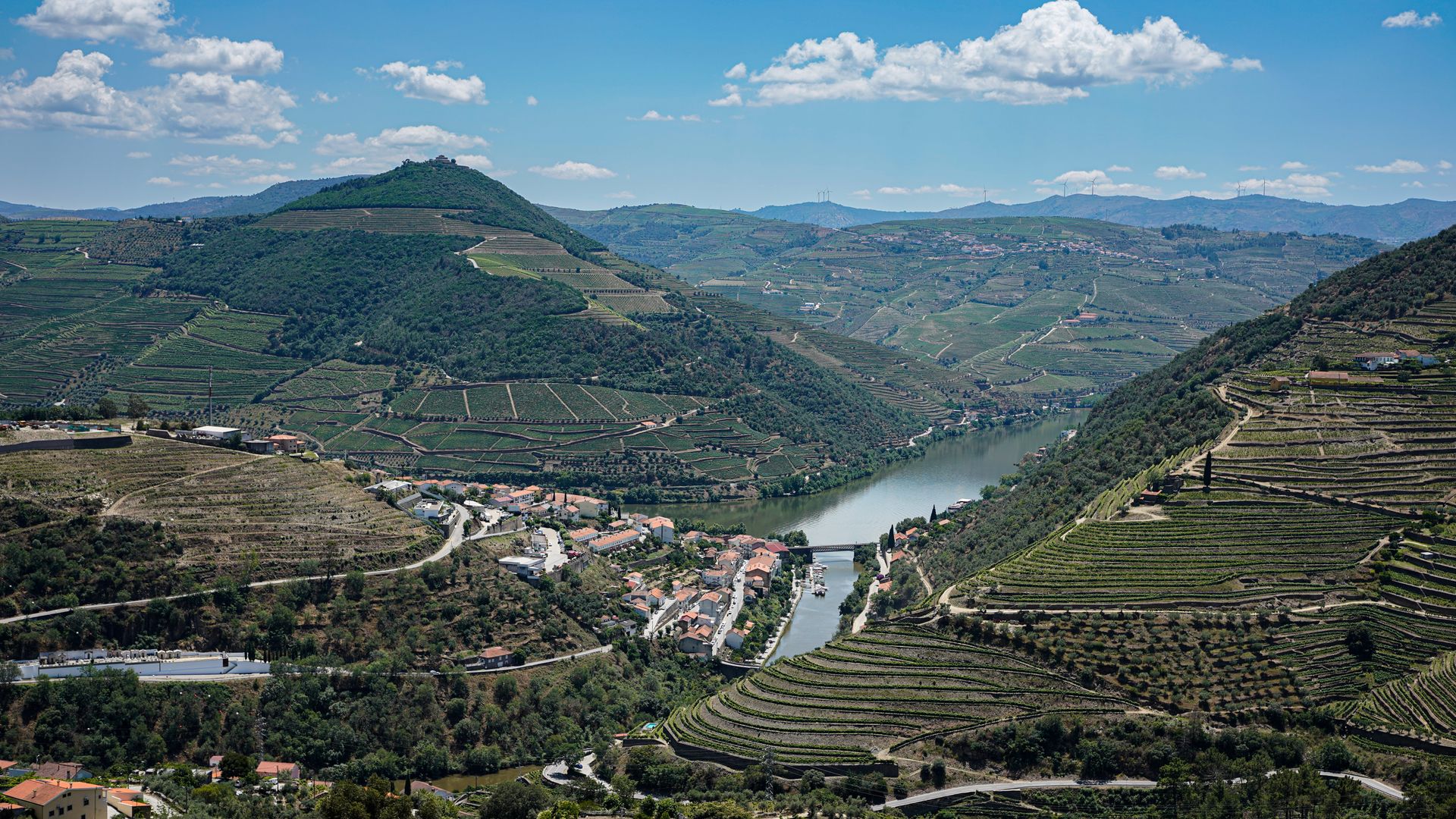
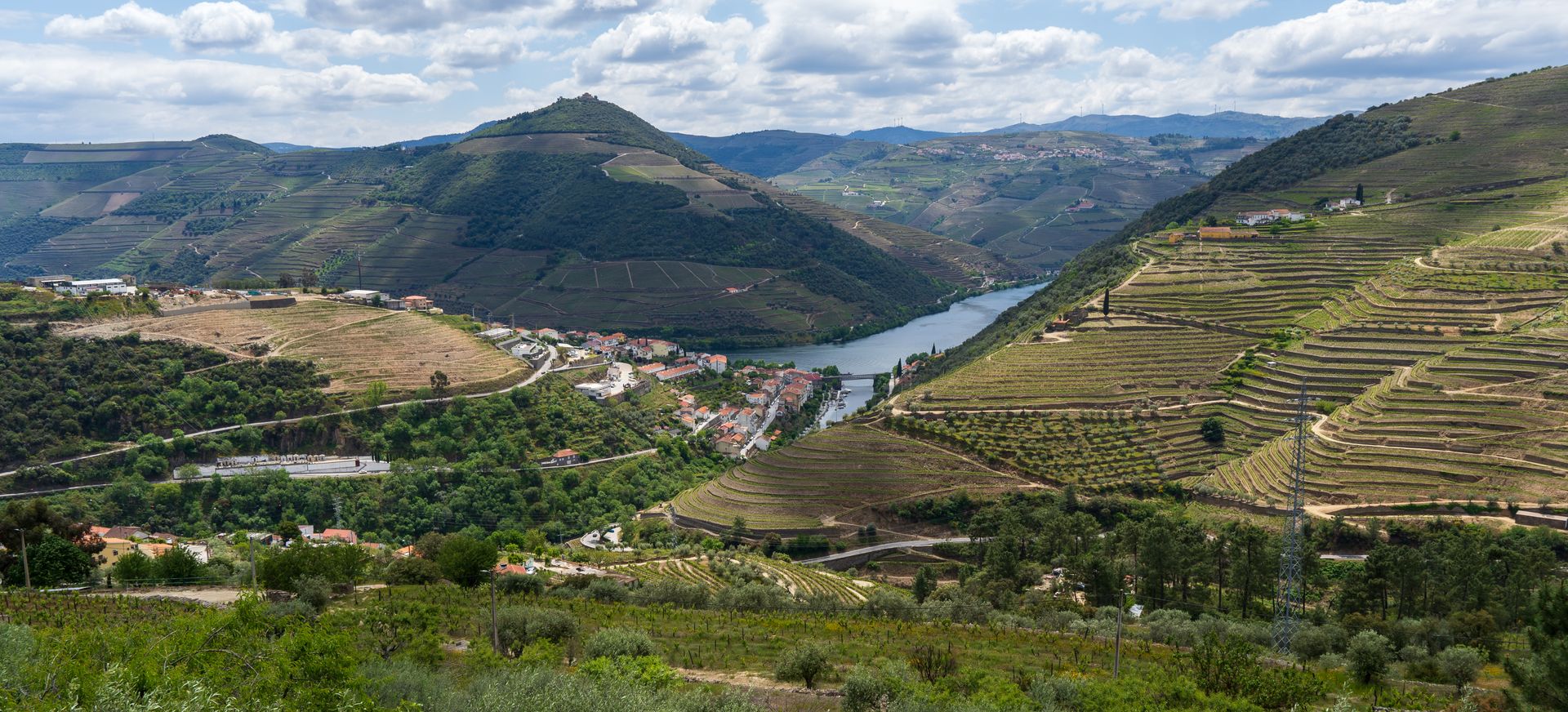
The Douro Demarcated Region runs to around 250,000 hectares of schist hillside along the river and its tributaries, of which about 43,800 hectares are planted with vines, under a fifth of the land. It divides into three sub-regions, and the difference between them is mostly rain.
| Sub-region | Vineyard | Rainfall | Character |
|---|---|---|---|
| Baixo Corgo | 13,200 ha | Up to 1,200 mm | Wettest and coolest, the most densely planted |
| Cima Corgo | 20,400 ha | Intermediate | The classic heart, where most of the great quintas sit |
| Douro Superior | 10,200 ha | As little as 380 mm | Hot, remote, barely a tenth of it planted |
There are something like 20,000 growers here, farming on average two hectares each. Hold that number against the château culture of Bordeaux and you understand the place at once: this is not a region of estates. It is a region of smallholdings on terraces so steep that a tractor is often out of the question, and the wine is bought, blended and aged by houses whose names you know from families whose names you never will.
The boundary was drawn on 10 September 1756, when a royal charter created a company to register every vineyard parcel, fix prices by assessed quality, ban additives and shut the region to outside wine. Between 1758 and 1761 the line was marked physically, with 335 granite posts, each cut with the word Feitoria: land judged fit to make wine for export. Chianti had been delimited in 1716 and Tokaj classified its vineyards in 1730, so the Douro is not the first wine region on earth to be drawn on a map. What it can fairly claim is to be the first given the whole apparatus, a border, a register, quality rules and a body to enforce them. UNESCO added the Alto Douro to the World Heritage list in 2001 as a living cultural landscape.
One detail worth carrying with you. The Museu do Douro has so far located only about 105 of those 335 granite markers. The eighteenth-century border of the world's first regulated wine region is still out there in the hills, and two thirds of it has never been found.
How Port is made
Red grapes are crushed and begin fermenting like any other wine. After two or three days, when the must has reached only five or six per cent alcohol and about half the sugar has gone, the winemaker adds aguardente vínica: neutral grape spirit at around 77 per cent, colourless, with no aroma or flavour of its own. The alcohol stops the yeast dead. Fermentation ends, the remaining sugar stays, and the wine is finished at between 19 and 22 per cent.
The ratio is about one part spirit to four parts wine, which is why a fifth of the volume of any bottle of Port is spirit. Until 1991 the shippers could not even choose it: the supply was a state monopoly.
More than a hundred grape varieties are authorised and around thirty recommended. In practice four do most of the work: Touriga Franca, about a quarter of all plantings, then Tinta Roriz, Touriga Nacional and Tinta Barroca.
Treading by foot, still
Crushing was traditionally done by foot, in shallow granite tanks called lagares, and at a handful of estates it still is, not as theatre but because nothing else extracts colour and tannin from thick-skinned Douro grapes so gently. At Quinta do Vesuvio every Port is still trodden entirely by foot, in lagares holding more than 13,000 litres, by teams of up to fifty people. The work begins with the corte, the cut: a disciplined march arm in arm across the tank, in silence, for about two hours. Only then does the music start and the treading turn into the party the postcards show. Elsewhere, robotic lagares developed in the late 1990s reproduce the same action mechanically, because the rural labour to fill a tank with fifty people no longer reliably exists.
The styles of Port, explained
Almost every question about Port is really a question about which style is in the glass. There are two families. Some Ports age in wood, in contact with air, and go brown, nutty and dry at the edges. Others age in bottle, sealed from air, and stay red and full of fruit. Everything on a label follows from that.
| Style | Aged in | Rule | What it is |
|---|---|---|---|
| Ruby | Vat | Young, fruity, blended across years | |
| Reserva | Vat | A better Ruby, more complex, still blended | |
| LBV | Wood | Bottled 4 to 6 years after harvest | A single harvest, bottled later than a Vintage |
| Crusted | Bottle | 3 years minimum in bottle | Blended across years, unfiltered, throws a deposit |
| Vintage | Bottle | Bottled by the third year | A single exceptional harvest, declared by the house |
| Single Quinta Vintage | Bottle | As Vintage | A Vintage from one estate, usually in an undeclared year |
| Tawny with age | Wood | 10, 20, 30, 40 or 50 years | A blend matched to the taste profile of that age |
| Colheita | Wood | 7 years minimum, often decades | A single harvest aged in wood |
| White | Wood or vat | Varies | From white grapes, dry to sweet |
| Rosé | Vat | Modern; the first was launched in 2008 |
Two things almost everyone gets wrong
An LBV is not defined by filtration. The law tells an ordinary Late Bottled Vintage from a Tradicional one by demanding extra years in bottle, not by asking whether the wine was filtered. Filtration is the commercial habit that follows; it is not the legal test. The traditional style must be bottled between the fourth and sixth year after the harvest and then rest at least three more years in glass before it may be sold.
The age on a Tawny is an opinion, not a measurement. The number on a 20 Year Old Tawny does not mean the wine is twenty years old, nor that the blend averages twenty. It means the tasting panel of the Douro and Port Wine Institute, the IVDP, recognises in it the character of a wine of that age. Nobody is counting candles. A 50-year category was created only in 2022; before that, anything older than forty could only be called Very Old.
And then there is the Colheita, the one that confuses collectors and then delights them. It is a single harvest, like a Vintage, but aged in wood rather than bottle, for a minimum of seven years and frequently for forty or fifty. A Colheita 1935 may have been drawn from its cask only recently. The date on the label is the harvest. The bottling date is separate, and often a lifetime later.
Who actually declares a Vintage year
This is the part almost no guide explains properly, and it is the most interesting mechanism in the wine world.
Nobody declares a Vintage year for the region. Each house decides for itself, every year, whether its own wine from that harvest is good enough to carry the word. There is no committee pronouncing 2024 a Vintage year. There is only a sequence of houses deciding one after another, and a point at which enough of them have done so that the trade calls it a general declaration.
The IVDP does not make that decision. It verifies it. Samples go in during the second year after the harvest; a blind tasting panel and a laboratory analysis must both pass; and before bottling, the Institute's officers count every bottle in every format and draw five samples from the batch to confirm it matches what was approved. That last step exists for an obvious reason. It makes it impossible to declare a small quantity and bottle a large one.
The Confraria do Vinho do Porto puts the whole division of labour in four words, and it is the clearest formulation anyone has managed: declaration belongs to the producer, certification to the IVDP, classification to the critics and the market, and celebration to the Confraria.
Historically the houses declare about three years in a decade. The general declarations this century: 2000, 2003, 2007, 2011, 2016, 2017 and 2024.
The 2024 was announced in spring 2026, seven years after 2017, the longest gap since the war years between 1935 and 1945. The Symington family declared it for Graham's, Dow's, Warre's, Cockburn's and Quinta do Vesuvio; the Fladgate Partnership for Taylor's, Fonseca and Croft; and Quinta do Noval for itself. Fladgate called it the smallest and rarest declaration in its history. If you have ever wanted to lay down a wine for a child, this is the year to ask about.
The single quinta: the second tier
In the years when a house decides against declaring, it may still bottle a Vintage from one estate, Graham's Quinta dos Malvedos, say, or Warre's Quinta da Cavadinha. These single quinta Vintages are a deliberate second tier, usually held back eight to ten years and released ready to drink rather than sold young. They are also, quietly, the best value in the category, because they carry the estate's name rather than the house's, and the market prices the difference.
The brotherhood that blends its rivals
The Confraria do Vinho do Porto was founded by public deed in Porto in November 1982, after attempts going back to 1964 had run aground on the difficulty of forming an independent association in the Portugal of the time. It is young by the standards of the Burgundian and Gascon orders, and it looks it: no medieval costume, no Latin. It has around 2,500 members, took Henry the Navigator, born in Porto in 1394, as its patron, and is governed by a chancellery of five, whose offices carry titles no other wine body still uses.
One of those five is the Copeiro-Mor, the Head Cupbearer, and in a declared year he does something no other wine body on earth does.
The Confraria's Vintage Celebration opens with a tasting at which the member producers show their declared wines. At the end of it, a bottle of every Vintage on the tables is poured together, and the Copeiro-Mor blends from them a single wine meant to stand for the year: competitors' wines, in one glass, made by hand into a portrait of the harvest. On a handful of occasions the chancellery has gone further and made a Confraria Vintage Port of its own, blended on the Copeiro-Mor's sole responsibility, submitted to the IVDP for certification like any other, and bottled under the brotherhood's name.
The last time it gathered for a declared year, in the gilded hall of the Palácio da Bolsa, Porto's old stock exchange, seventy-two Vintage wines from forty-eight brands were poured, and the blend was made by the head winemaker of one of the largest houses in the valley, from the wines of everyone who competes with him. Try to imagine Bordeaux doing that. You cannot, and neither can Bordeaux.


The boats they saved
The same Confraria revived something else. Rabelo boats, flat, keel-less, steered by a long stern oar, carried the pipes of Port down the rapids from the Douro to the cellars at Gaia until the last commercial voyage in 1963. Twenty years later they were rotting. In 1983 the Confraria organised a regatta to save them, and it has run every year since, on the afternoon of 24 June, the feast of São João, from the river mouth at Afurada up to the Dom Luís I bridge, each boat carrying a Port house's name on its sail. The whole of Porto is on the quays, half of it holding a plastic hammer, which is another story.
Why Port was aged a hundred kilometres from the vines
The lodges of Vila Nova de Gaia are not where the wine is made. They are where it was sent.
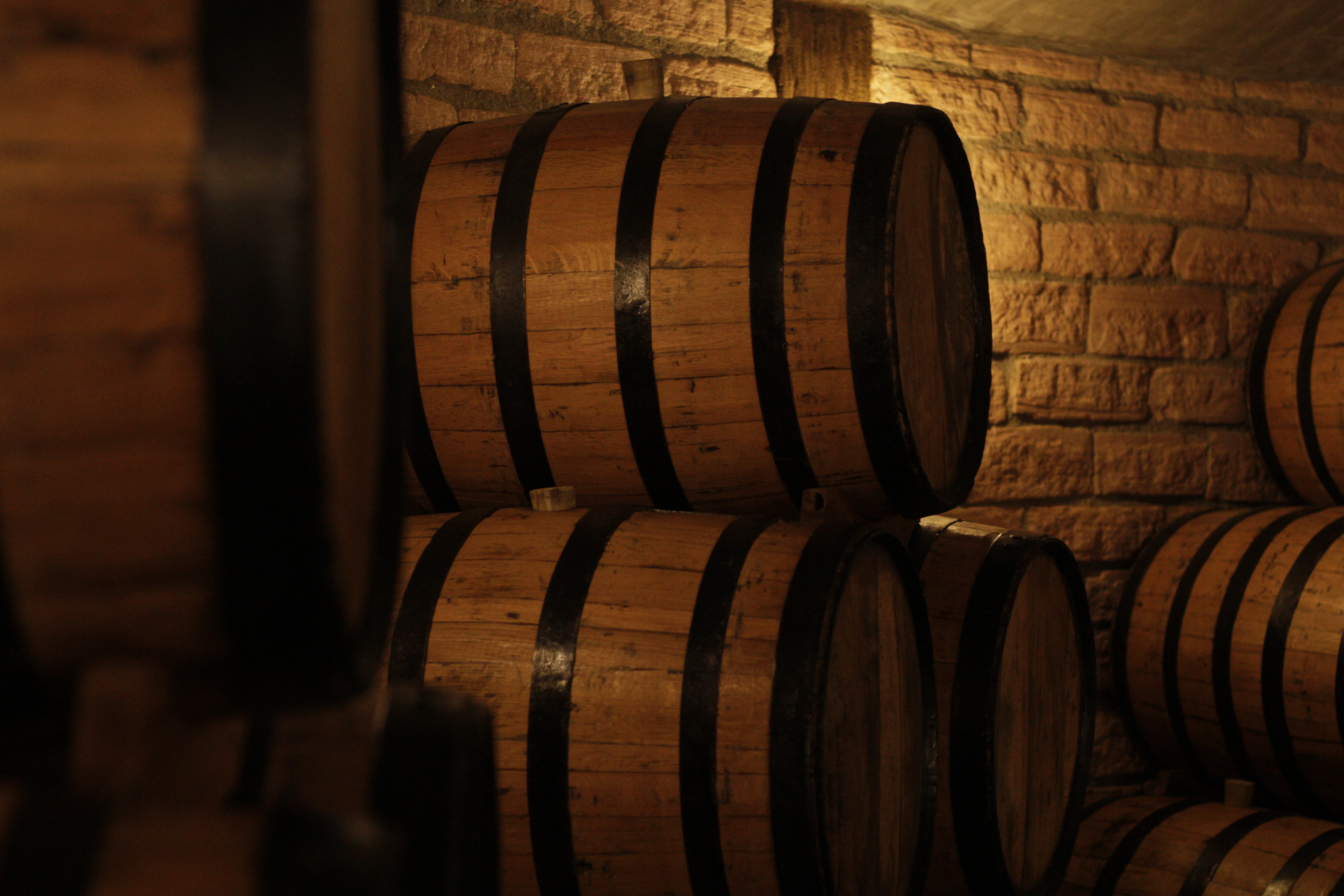
A lodge, an armazém, is an ageing warehouse, and Gaia has them because of its climate: north-facing slopes at the river mouth, sheltered from the wind off the bar, cool and stable all year. The Douro in summer is not. Heat hurries cask ageing and coarsens the wine, so for two centuries the pipes went downriver to mature. From 1926 the habit became law: an entreposto of 250 hectares was defined at Gaia, and Port had to be stored inside it. That rule was lifted in 1986, and a great deal of Port now ages at the quintas in the valley.
One restriction still stands, and it is the reason Port is Portuguese in a way most wines are not. Port may not be shipped in bulk out of either the Douro or the Gaia entrepôt. It has to be bottled inside those boundaries first. In Portuguese law, certification is not finished when the wine is analysed. It is finished when it is in the bottle.
What Port actually costs
Less than you would expect at the top, and far less than the equivalent in Bordeaux or Burgundy.
A newly declared Vintage from a leading house cost roughly £50 to £70 a bottle in bond on release this autumn: Warre's at £47, Dow's and Graham's at £58, Taylor's and Fonseca at £66. Prestige bottlings from the same declaration went higher, Graham's The Stone Terraces at £170, Quinta do Vesuvio Capela at £130. That is the entry price for a wine engineered to be drinkable in fifty years, and it is the price of a very ordinary Saint-Julien.
Old bottles are a different market. A Kopke Colheita 1935 sells for under a thousand dollars. A Ferreira 1815 Vintage is offered at around £20,000. In 2010 Taylor's bought a cask of pre-phylloxera 1855 Port from a Douro family whose last heir had died childless, and released it as 1,400 hand-blown crystal decanters at £2,500 each.
The record belongs to a Niepoort 1863 in a Lalique decanter, one of five made, each engraved with the name of one generation of the family. It sold at Sotheby's in Hong Kong in March 2019 for HK$1,054,000, about US$134,000, the Guinness world record for a fortified wine. A hundred and fifty-six years after it was trodden by people whose names nobody wrote down.
Visiting the Douro: when to go, what is worth doing
Harvest runs from roughly mid-September to the first week of October, whites first. It is the most interesting time to be in the valley and the worst one to organise late; the good quintas are committed months ahead.
May and June give you the terraces at their greenest, long light and warm days without the inland furnace. Late September and October give you the harvest itself and the first turn of the vines. July and August are genuinely hot inland around Peso da Régua, well into the thirties, and the river does not cool it. Late October and November are beautiful, copper vines and low light, and wetter.
In Gaia, the big houses run permanent visits, some of them very well done, with audio guides in a dozen languages and a Vintage opened with heated tongs if you ask. You do not need us for those. Book one, enjoy it, and understand that you have seen the shop window.
The version worth crossing Europe for
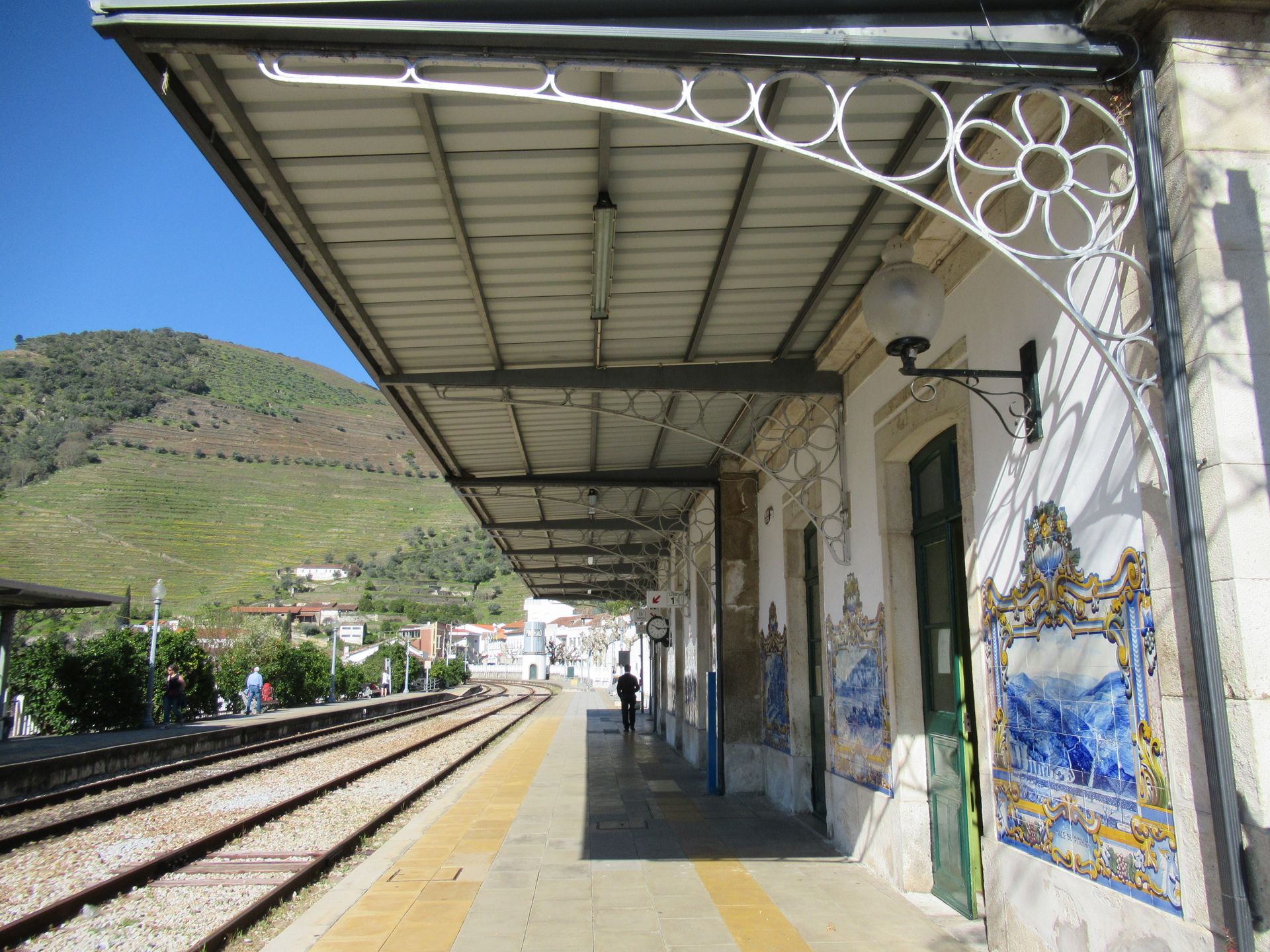
I will be direct, because the lodge tours will not be. They are good, and they are what everyone does, and they are in Gaia, which is a suburb. What a well-travelled visitor actually wants is upriver: a single quinta with its own lagar, a vertical of one estate across four decades poured by the person who made the last three, a morning in the terraces at picking time and a table on a terrace above the water at the hour the schist gives its heat back. That is arrangeable. It is not what the lodges sell, and it is the trip we build, usually as the northern chapter of a longer Portugal that starts in Lisbon and ends on the Alentejo coast. If your appetite is for the table rather than the cellar, the Douro's unfortified reds deserve a day of their own.
Frequently asked questions
Is Port wine sweet or dry?
Most Port is sweet, because fermentation is stopped before the sugar is used up. The legal scale runs from Extra Dry, 17.5 to 40 grams of residual sugar per litre, through Dry, Medium Dry and Sweet to Very Sweet, over 130. Dry White Port exists and is drunk in Porto as an aperitif, with tonic and a sprig of mint.
How is Port different from ordinary wine?
Grape spirit is added during fermentation rather than after it. That leaves sugar in the wine and raises it to 19 to 22 per cent alcohol, against 12 to 14 for a table wine. About a fifth of the volume of the bottle is that spirit.
Where does Port wine come from?
The Douro Valley in northern Portugal, demarcated in 1756. The name is legally protected: only wine from that region, made to the specification and bottled inside it or in the Gaia entrepôt, may be called Port.
What does Port taste like?
A Ruby or a Vintage tastes of blackberry, plum and cassis with firm tannin. An aged Tawny tastes of walnut, dried fig, caramel and orange peel, with much less fruit and a drier finish. They are the same wine, aged two different ways.
How long does Port last after opening?
From one to two days for a Vintage to one to three months for an aged Tawny or a Colheita. Ruby, Reserva and filtered LBV keep two to three weeks.
Should Port be chilled?
Tawny and White, yes, lightly. Vintage and LBV, no: cool room temperature, and a decanter if the bottle is over fifteen years old.
Who decides if a year is a Vintage year?
Nobody, centrally. Each house decides for its own wine and submits it to the IVDP, which verifies it by blind tasting and analysis. When enough houses declare, the trade calls it a general declaration. The recent ones are 2011, 2016, 2017 and 2024.
How much does a bottle of Vintage Port cost?
Around £50 to £70 on release from a leading house; prestige bottlings from the same declaration run to £130 to £170. Old and rare bottles reach five figures, and one Niepoort 1863 reached six.

Here is what stays with me about Port, more than the prices and more than the granite posts nobody can find. It is a wine made by twenty thousand smallholders, sold under the names of a dozen families, aged for decades by people who will not be there to open it, and celebrated, when the year is good enough, by a brotherhood that pours everyone's best into one glass and calls it the harvest.
The French confréries would never. That is exactly why you should go.