
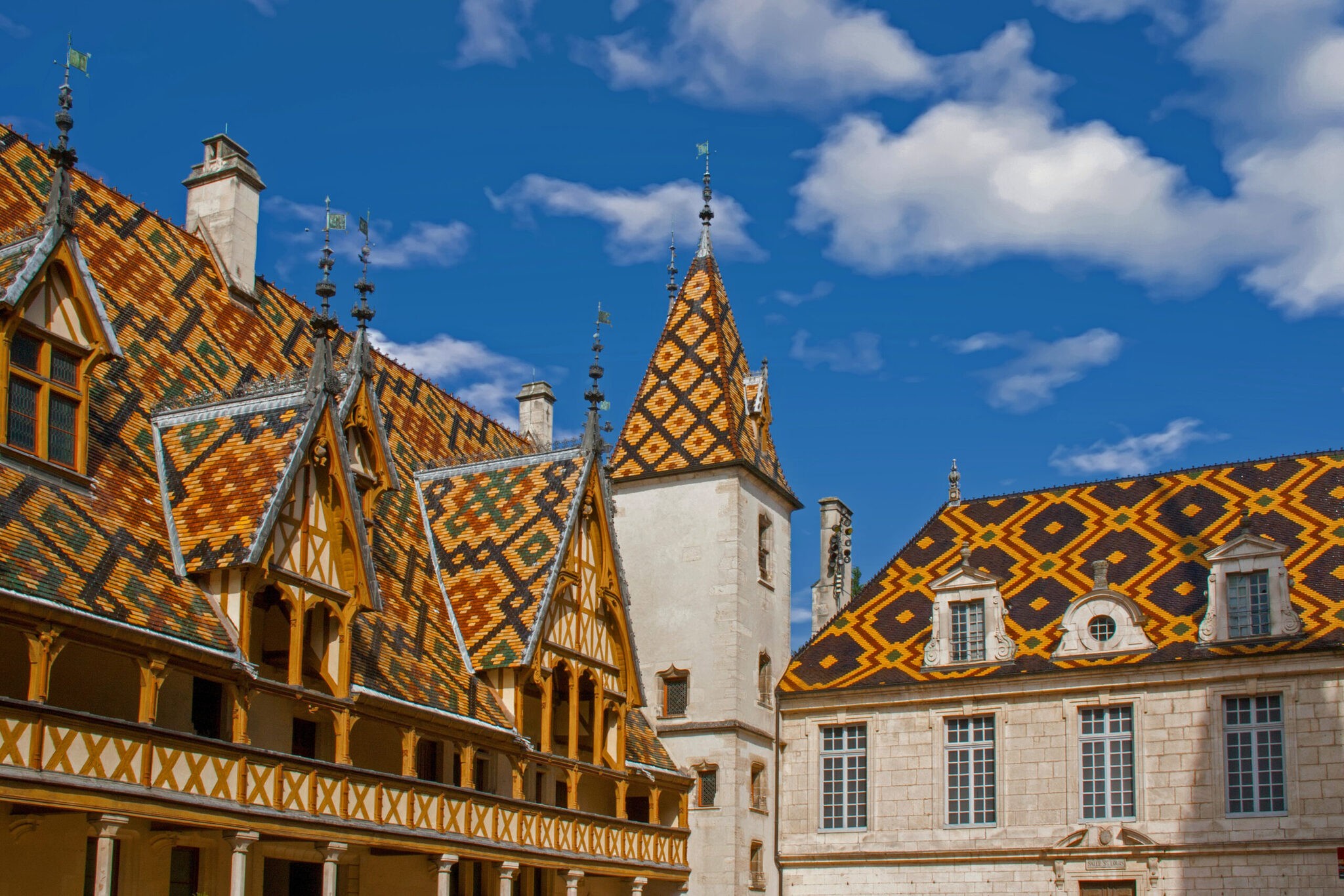
Start with the part that makes no sense. The wine sold in Beaune on 15 November was picked in September, it has finished fermenting and nothing else, and it will not be worth drinking for another five years. It is opaque. It tastes of raw fruit and wood. Nobody bidding on it has swallowed a mouthful, because there is no mouthful to swallow.
Last year they spent 18,754,670 euros on it in an afternoon.
The club that dressed up to sell wine
People have been bidding on that wine since 1859. The three days that now surround it are ninety years younger, and they exist because of a catastrophe.
In the early 1930s Burgundy had a run of superb vintages and no buyers at all. The crash had taken the Americans, the British and most of the French, and the cellars simply filled up.
On 16 November 1934, in a cellar at Nuits-Saint-Georges, two friends decided to do something about it. Camille Rodier wrote about wine, Georges Faiveley sold it, and what they invented was not a marketing plan but a brotherhood: a ceremony borrowed from the drinking societies of the eighteenth century, robes in crimson and gold copied from the gowns of doctors of theology, a motto that runs roughly never in vain, always in wine, and knights.
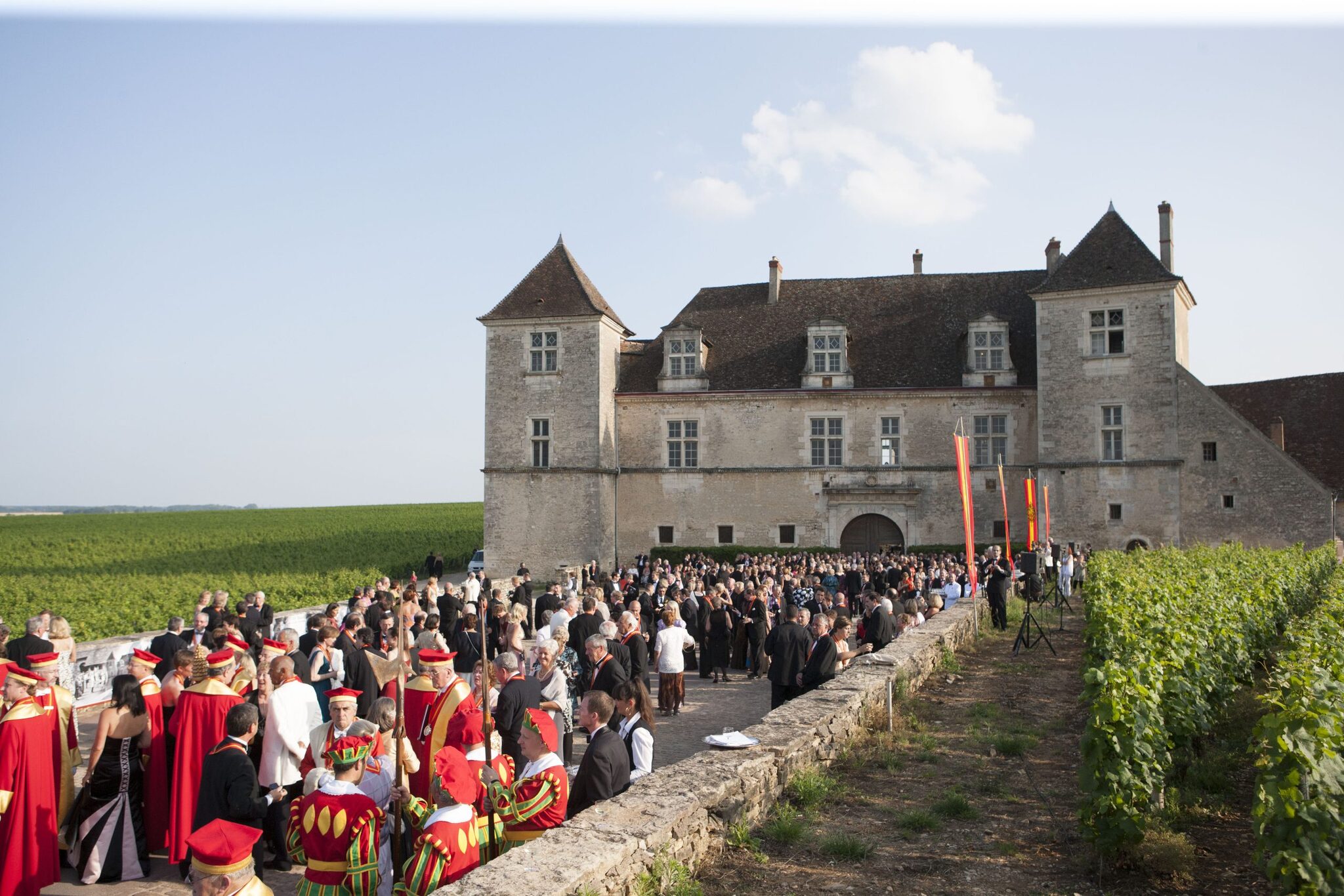
It should have been ridiculous. Instead the Confrérie des Chevaliers du Tastevin now holds sixteen chapters a year, counts some twelve thousand members across seventy-five branches, and has knighted a king of Sweden. In 1944 it bought the ruined Château du Clos de Vougeot and restored it.
And the wine nobody wanted? A hectare of ordinary appellation land in the Côte-d’Or now averages 1,022,649 euros. A hectare of premier cru white, two and a half million. The grands crus have no official price at all, because they change hands too rarely for anyone to publish an average.
What happens on 15 November
At half past two, under the covered market opposite the Hôtel-Dieu, Sotheby’s begins selling the year’s harvest from the Hospices’ own vineyards. Two auctioneers take turns. It lasts six and a half hours.
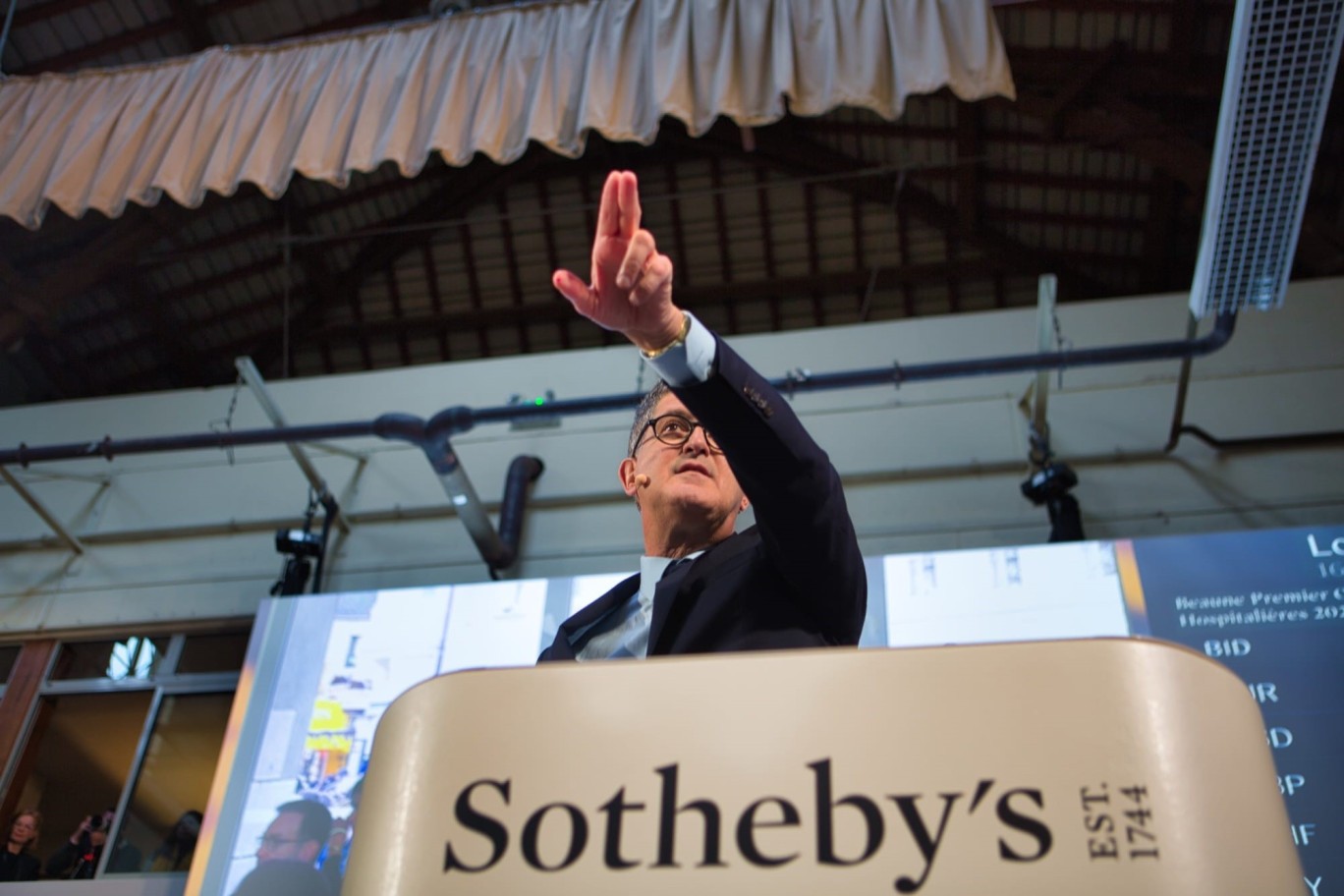
There are no bottles in this sale. There never are. It is a sale en primeur, held weeks after the picking, and the only thing on offer is casks: last year 428 of thirty-four red wines, 111 of eighteen whites, eleven of marc and fine de Bourgogne, and the charity barrel. You can buy a half cask, or a quarter. You cannot buy a bottle, and no old vintages are ever put up beside it.
The unit is the pièce, the Burgundian cask of 228 litres, which becomes 288 bottles, twenty-four cases of twelve. In 2025 the average pièce went for 33,930 euros, whites at 58,580 and grands crus at 86,290. The total, 18,754,670 euros at the hammer, was the third highest ever. Not a record, whatever you read in November: that is still 2022, at 28.9 million.
Then the real work starts, and it is yours. The law forbids you to take the cask home: you hand it to an approved merchant who raises the wine and bottles it, and a cask bought this November reaches you in glass some time in 2028. On top of the hammer price come eight per cent to the auction house, twenty per cent VAT, the cask, and the merchant’s bill for two years of work, which Sotheby’s declines to estimate because it depends on the merchant and the wine.
Which means you are buying two things, and the second one is a person. Two buyers can take the same cuvée from the same auction and hand it to two different houses, and what reaches the table two years later will not be the same wine. That is why the label names the merchant alongside the benefactor who gave the vines and the arms of the Hospices. It can carry your name as well, subject to approval.
Private individuals have bid since 2005 and online since 2007; you register with Sotheby’s first, and seats are granted rather than sold. The competition is not local. In the run-up to last year’s sale the auction house ran twenty-four tastings across seventeen cities, from Abu Dhabi to São Paulo.
The wine comes from sixty hectares and more than a hundred and twenty parcels, farmed organically by twenty-three winegrowers who each look after about three. Ludivine Griveau has run the estate since 2015, the first woman ever to do so. Not one of those hectares was bought. Every one arrived as a legacy or a gift, the first in 1457, and it is still happening: in 2025 a new cuvée appeared, a Clos de Vougeot grand cru given by the Faiveley family, the same name as the man who invented the brotherhood ninety years earlier. Its two casks sold for 165,000 and 170,000 euros.
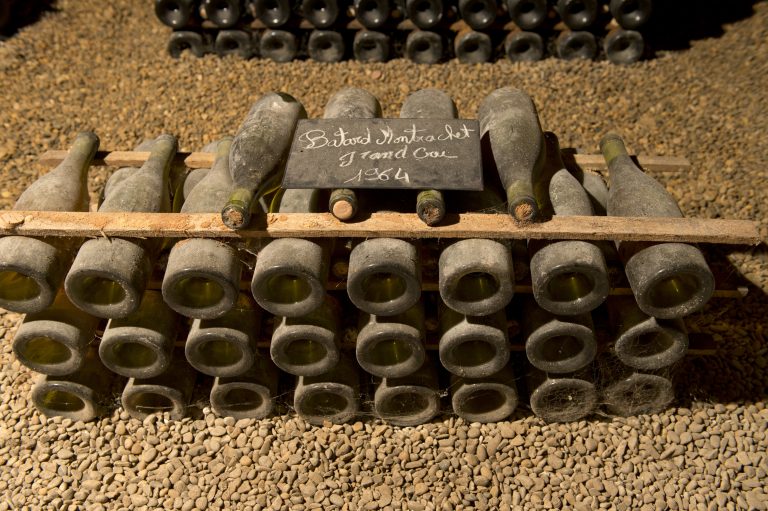
The naming runs deeper than it looks: the estate’s Corton is not one wine but four, split by climat and sold under four different benefactors’ names, so two lots of Corton in the same sale are two different hillsides. Scarcity here is arithmetic rather than marketing. The estate’s rarest wine, a Bâtard-Montrachet, makes two and a half casks in a good year, about seven hundred bottles for the entire planet, and in 2025 each of the two full casks went for 400,000 euros. That is roughly 1,390 euros a bottle before anyone has bottled anything. The half cask is not a marketing device either: when a parcel is too small to fill a round number of barrels you sell the half, and it has its own name, a feuillette.
What we already know about 2026
Most of what gets written about this sale in September is guesswork. Here is the line between what is established and what is not.
The harvest is in, and it broke a record. Picking began on 15 August 2026, the earliest start in the estate’s history, a day ahead of 2020. It was over in nine days.
The year that produced it was brutal in a specific way: a light frost in late March, then drought from late May straight through to the picking, heatwaves from 18 June, and close to fifty days above the seasonal norms. Flowering happened in that heat, which brought coulure and millerandage, loose bunches and uneven berries.
Ludivine Griveau described fruit the team was not used to handling: more concentrated, thicker skins, less juice inside. That ratio is the whole story. Colour, tannin and structure live in the skin, so a year of small thick-skinned berries is a year of concentration, high degrees and firm tannin, and a small one. Asked in August whether it would be a great vintage, she gave the only honest answer available. She had no idea, and did not intend to tell anyone stories.
Pommard is the thread of this edition, because the appellation turns ninety: created on 11 September 1936, 314 hectares, all pinot noir, twenty-eight premiers crus. The Hospices own 7.2 hectares of it, including Les Rugiens and Les Epenots, which make five of their cuvées. What the anniversary means inside the sale itself comes with the catalogue, on 22 October.
The charity barrel has a cause and two names. The 2026 Pièce de Charité goes to rare diseases, and on 7 September the Hospices named the beneficiaries: Debra France, which works on epidermolysis bullosa, and Arsla, on motor neurone disease. The godparents who will preside over the sale are revealed on 22 October, in Paris, at the press conference that also publishes the catalogue.
The volumes land on 22 October, with the catalogue and the names of the presidents, at a press conference in Paris. Anyone quoting a number of casks before then is guessing, and the swing is violent enough to make guessing pointless: 753 casks in 2023, 439 in 2024 after mildew took two fifths of the crop, 539 in 2025. After a harvest this short, expect the low end.
| Date | What | Access |
|---|---|---|
| 22 October | Press conference in Paris: catalogue, number of barrels, presidents | Press |
| 13–14 November | 153rd Fête des Grands Vins de Bourgogne, Palais des Congrès | Ticketed |
| 13–15 November | The town’s own festivities: funfair, food market, folklore parades | Open |
| Saturday 14 | Chapter of the Chevaliers du Tastevin, Château du Clos de Vougeot | Invitation |
| Sunday 15, 2.30pm | The 166th sale, under the Halles, by Sotheby’s | Registered bidders |
| Monday 16 | Paulée de Meursault, Château de Meursault | Invitation |
One calendar trap worth knowing: the Trois Glorieuses run Saturday to Monday, while the town’s festivities start on the Friday and finish on the Sunday. They are not the same three days, and people book the wrong nights every year.
Saturday 14
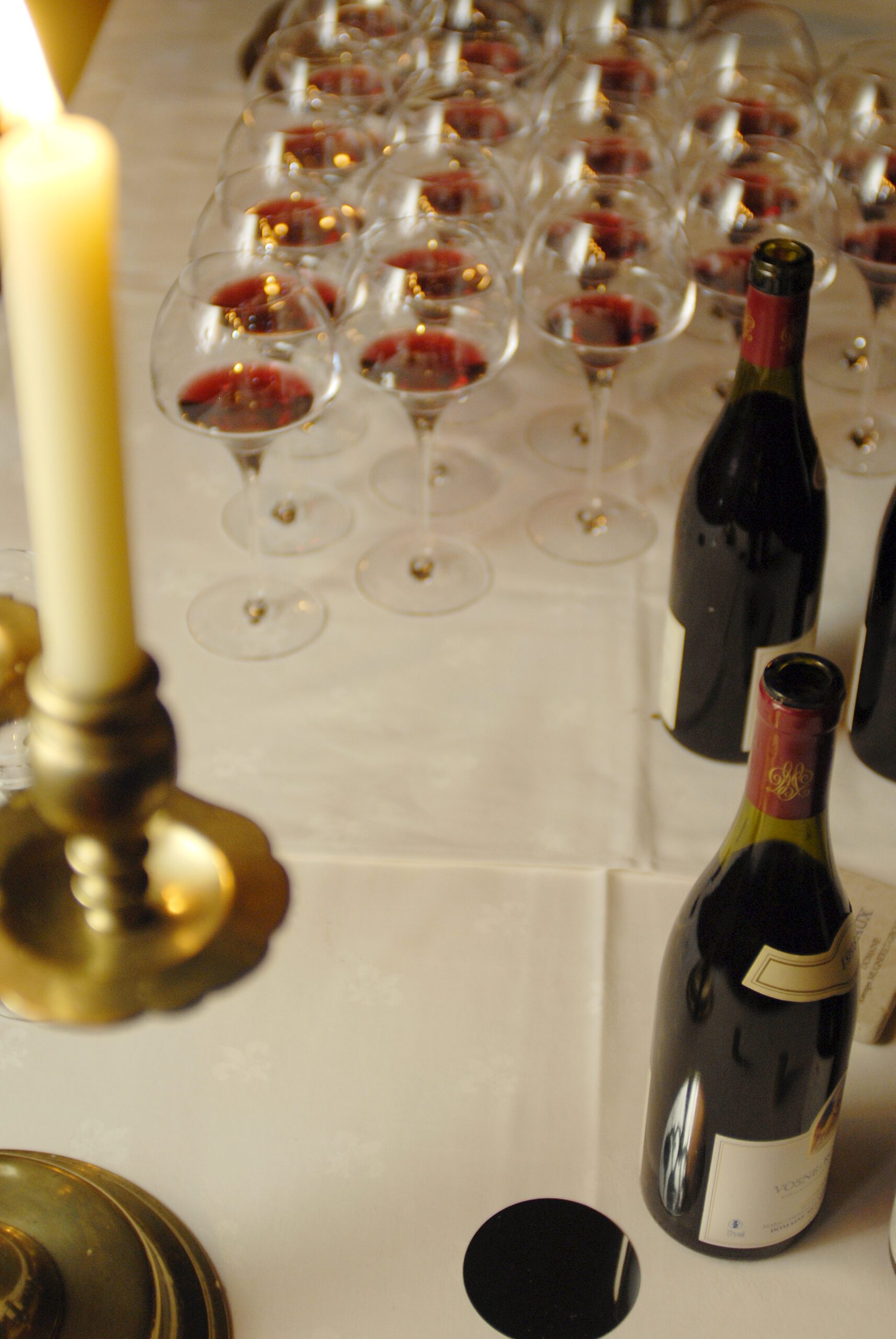
The chapter at Clos de Vougeot: black tie, the cep on the shoulder, six hundred at table, and the Cadets until the small hours.
Sunday 15

The sale, from 2.30pm under the Halles. Outside, the whole town is open: cellars, growers, a market.
Monday 16
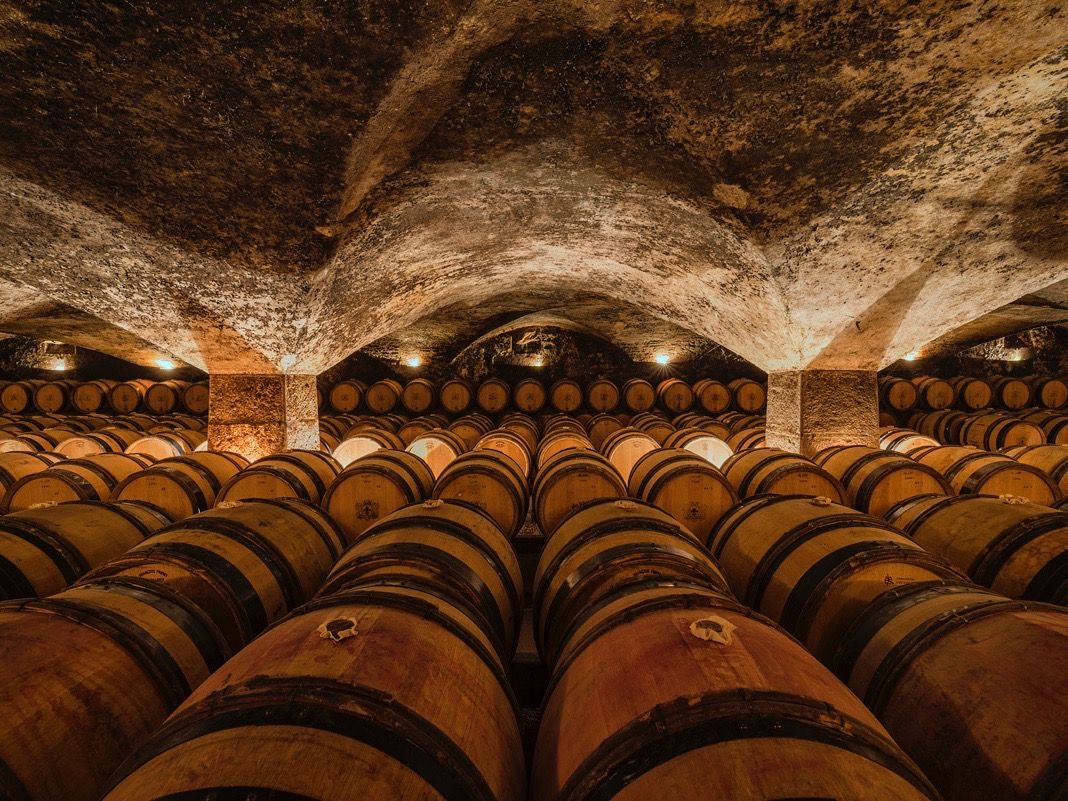
The Paulée de Meursault: around seven hundred and fifty people, and everyone brings their own bottles.
The Paulée deserves its own line. It began as the meal a landowner owed his pickers, took its present form in 1923, and is now the least formal and most alarming lunch in France: some twelve hundred bottles are opened, more than one and a half a head, and they are not the organisers’. Each guest brings his own and pours it down the table. Since 1932 it has awarded a literary prize, paid in a hundred bottles of Meursault.
Where the money actually goes
This is the part that stops it being folklore.
The Hôtel-Dieu was founded in 1443 by Nicolas Rolin, chancellor to the Duke of Burgundy, as a hospital for the poor in a town ruined by war and plague. Patients were nursed under its painted beams until 1971; it became a museum in full in 1988 and now takes four hundred thousand visitors a year. Donors left it vineyards for five centuries, which is how a charity ended up owning grand cru.
The hospital those vines pay for is still running, and it is being rebuilt right now: fifteen thousand square metres across two buildings, one for day patients and one for wards, more than eight rooms in ten of them single, due at the turn of 2027 and 2028. The works alone are sixty million euros before tax, inside a project the hospital’s own communications have put at anywhere between eighty-six and ninety-seven million depending on the year and the scope counted.
The state is paying a small fraction of it. The minister who laid the first stone said out loud what everyone in the room was thinking, that it was exceptional for the state to give so little to a hospital. The rest comes, as it has since 1443, from selling wine in November. The Hospices have never published what share of the bill the auction covers, and I am not going to put a percentage on it for them.
How to be there
For three days Burgundy stops behaving like a market and behaves like a village, and most of it happens behind doors. Be clear about which ones. The chapter and the Paulée are invitations, not tickets, and no agency can sell you a seat at either. Places in the auction room are granted by Sotheby’s, case by case, to people who intend to bid.
What is genuinely open is the rest, and it is a great deal. The whole of Beaune opens its cellars that weekend, the growers pour, and you can taste the previous vintage of the very cuvées going under the hammer, in the room where the wine was made. What we add is the part that is not advertised: a grower who opens older vintages after hours, a table that stopped taking bookings in August, someone who knows which gate is unlocked, and, where the relationship allows it, an introduction that is not for sale.
Where to stay. Book by spring. In the vines, COMO Le Montrachet at Puligny and the Hostellerie de Levernois; in town, the Hôtel Le Cep. Beyond those the good rooms are private houses, which is usually the better answer for three nights in November.
Frequently asked questions
When is the Hospices de Beaune auction in 2026?
Sunday 15 November, from 2.30pm, under the covered market. Les Trois Glorieuses run Saturday 14 to Monday 16; the town’s own festivities run Friday 13 to Sunday 15, which is a different calendar and a different set of nights to book.
Can anyone attend the sale?
Seats are granted by Sotheby’s to bidders, not sold as tickets. The weekend around it is open: cellars pour across Beaune and the sale runs on screens in the town.
Can you buy bottles rather than a cask?
No, and you never could. Casks only, plus eleven of marc and fine de Bourgogne last year. Half and quarter casks exist; bottles and old vintages do not.
Is the wine still sold by candle?
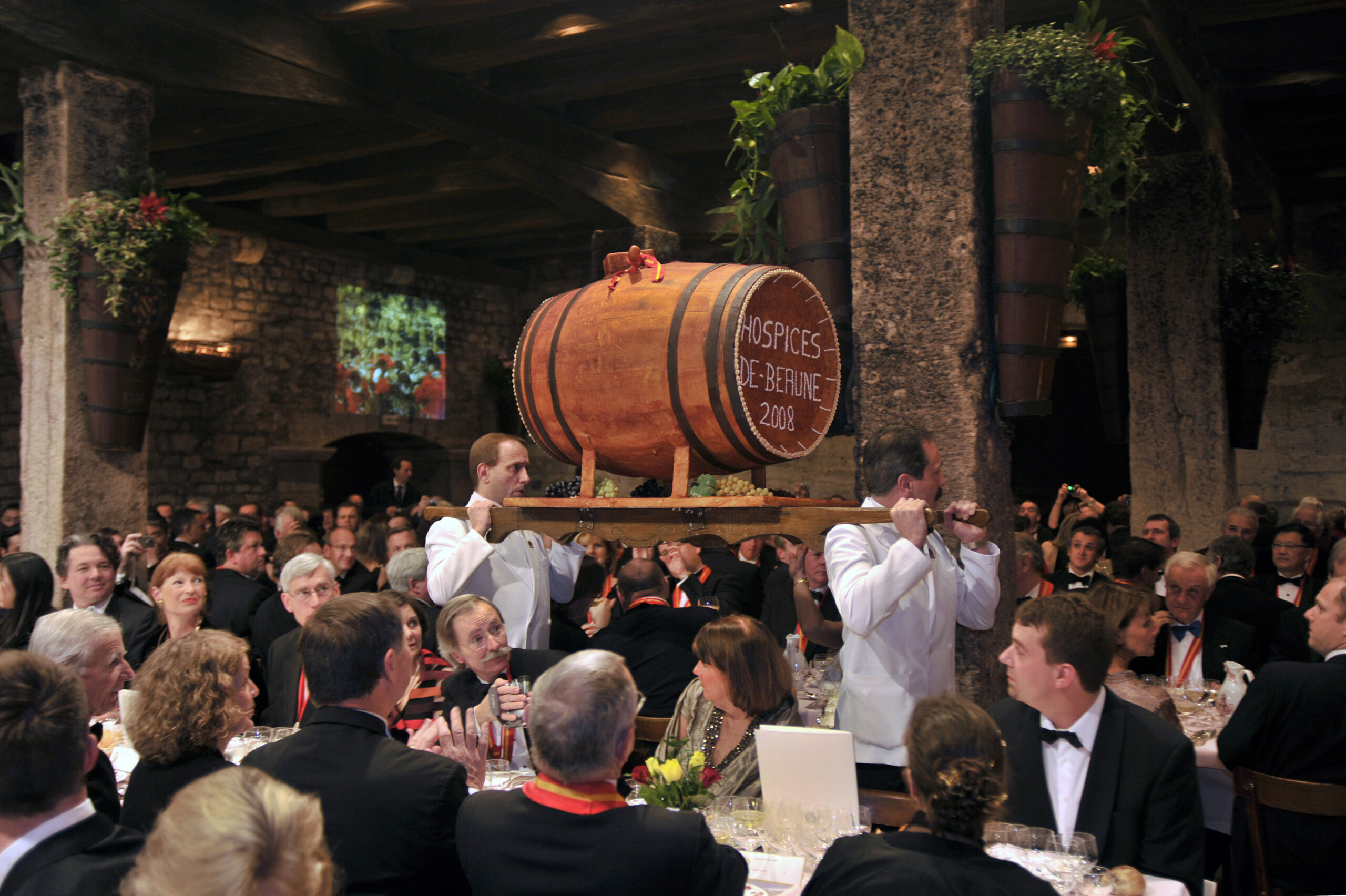
One lot only. The sale has run at the hammer since 2005. The charity barrel keeps the old method: two wicks lit in succession, and the cask goes to whoever spoke last when the second dies.
Can you be made a Chevalier du Tastevin?
Yes, and you do not have to make wine: the Confrérie asks only that two existing members sponsor you. At the chapter the Grand Maître lays a cep, the trunk of an old vine, on each shoulder in place of a sword, and a crimson and gold cord goes round your neck carrying a small silver tasting cup. Actors, a DJ and a film director were knighted alongside the growers last November.
What is the most expensive cask ever sold?
Two answers. The charity barrel reached 810,000 euros in 2022, but that is a donation rather than a price. The highest paid for an ordinary lot is 400,000 euros, a Bâtard-Montrachet grand cru, in 2025.
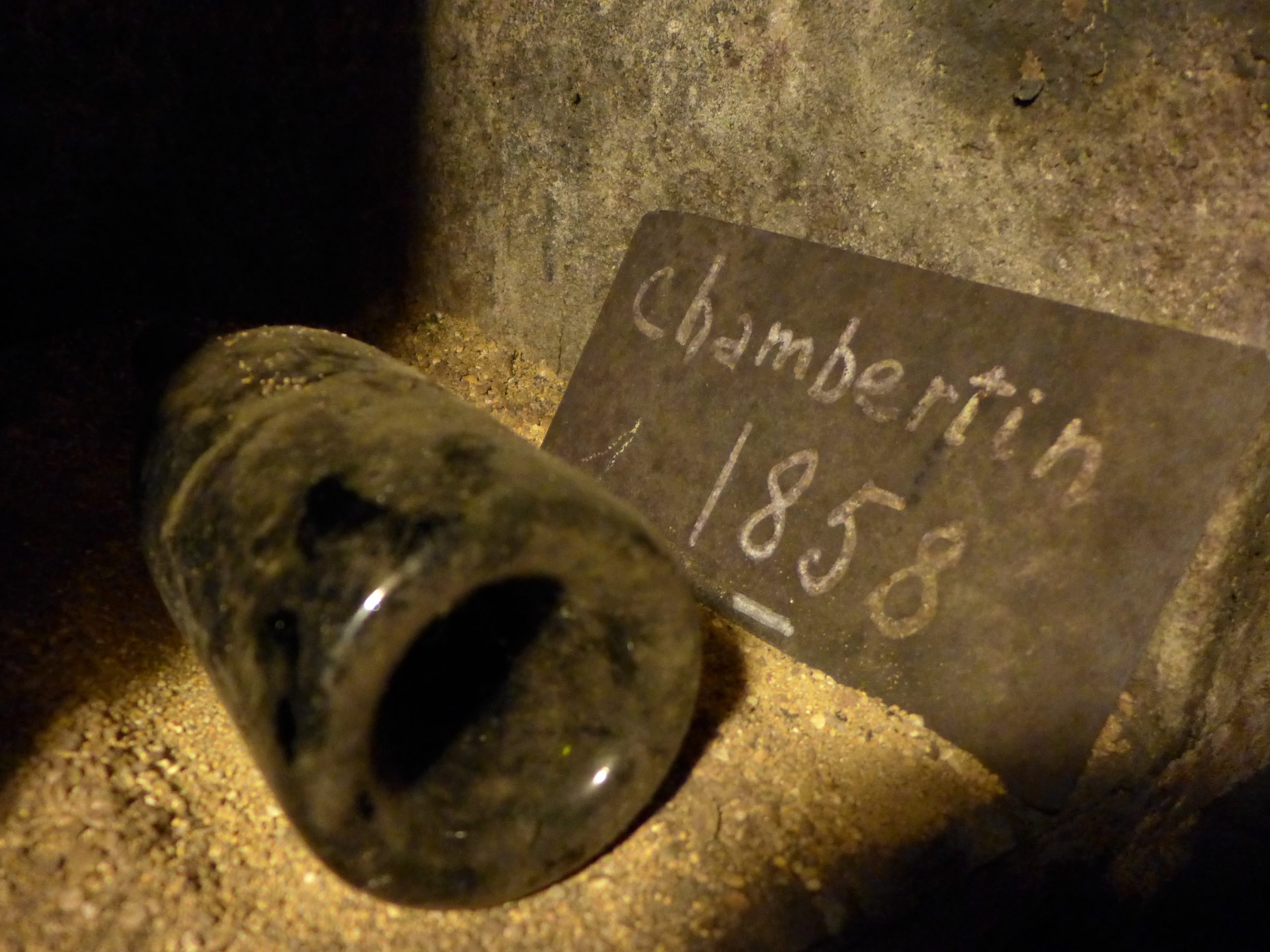
In a cellar in Beaune there is a bottle with Chambertin 1858 chalked on the neck, in the hand of someone who has been dead for a century. That is the whole point of the place: somebody kept it.
Two men could not sell their wine, so they made up a club with robes and a silly song and a vine for a sword. Ninety years later their region is the most expensive farmland in Europe, and the strangest auction in the world pays for a hospital that is still admitting patients.
It is worth going in November, while it is still work rather than heritage.