
Cities carved into rock, a lake you cross by rowboat in the dark, wine ageing in Roman quarries, walls painted before history. None of it comes to you. You go down to it.
The world belowEverything you flew to Europe to photograph is above ground, in the sun, with a line in front of it. The best of it is underneath: a whole continent below the streets and the vineyards, in the cold and the dark, where your phone is no use to you. You go down to reach it, and that is exactly why it stays with you.
The descent works on the senses before it works on the mind. The light goes first, then the noise of the world above, then the warmth. Your eyes adjust. You start to hear water somewhere, or your own footsteps, or nothing. What rises to meet you is not emptiness but evidence: tool marks in soft stone, a date scratched on a wall, a chapel where there should be only rock. People have come down here for two thousand years and more, to hide, to pray, to dig, to keep wine. They left the proof.
It is also, literally, the coolest place to be in a European summer. While the squares bake at thirty-eight degrees, the underworld holds a steady ten or twelve, quiet and half-empty. Worth the descent in any season; in August, close to a secret.
Five Descents, Side by Side
Wine, a buried city, a refuge, the first art, and a lake in the dark.
| Where | What it is | The descent | Don't miss |
|---|---|---|---|
| Champagne | Roman chalk cellars | 30 to 40 m, a steady 10°C | Millions of bottles in the dark |
| Naples | The city beneath the city | ~40 m | Greek aqueduct & WWII shelters |
| Cappadocia | An underground city | ~85 m, 18 levels | Derinkuyu's sealing stones |
| Dordogne | Prehistoric painted caves | Into the hillside | Font-de-Gaume's real polychrome |
| Saint-Léonard | Europe's largest underground lake | 300 m long, 30 to 70 m down | A concert from a rowboat |
Champagne: The Cellars That Were Roman Quarries
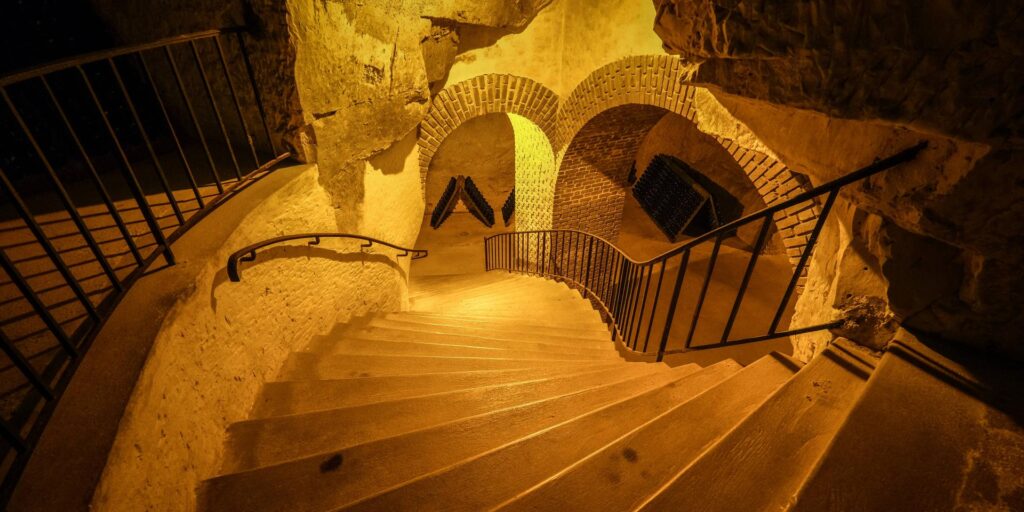
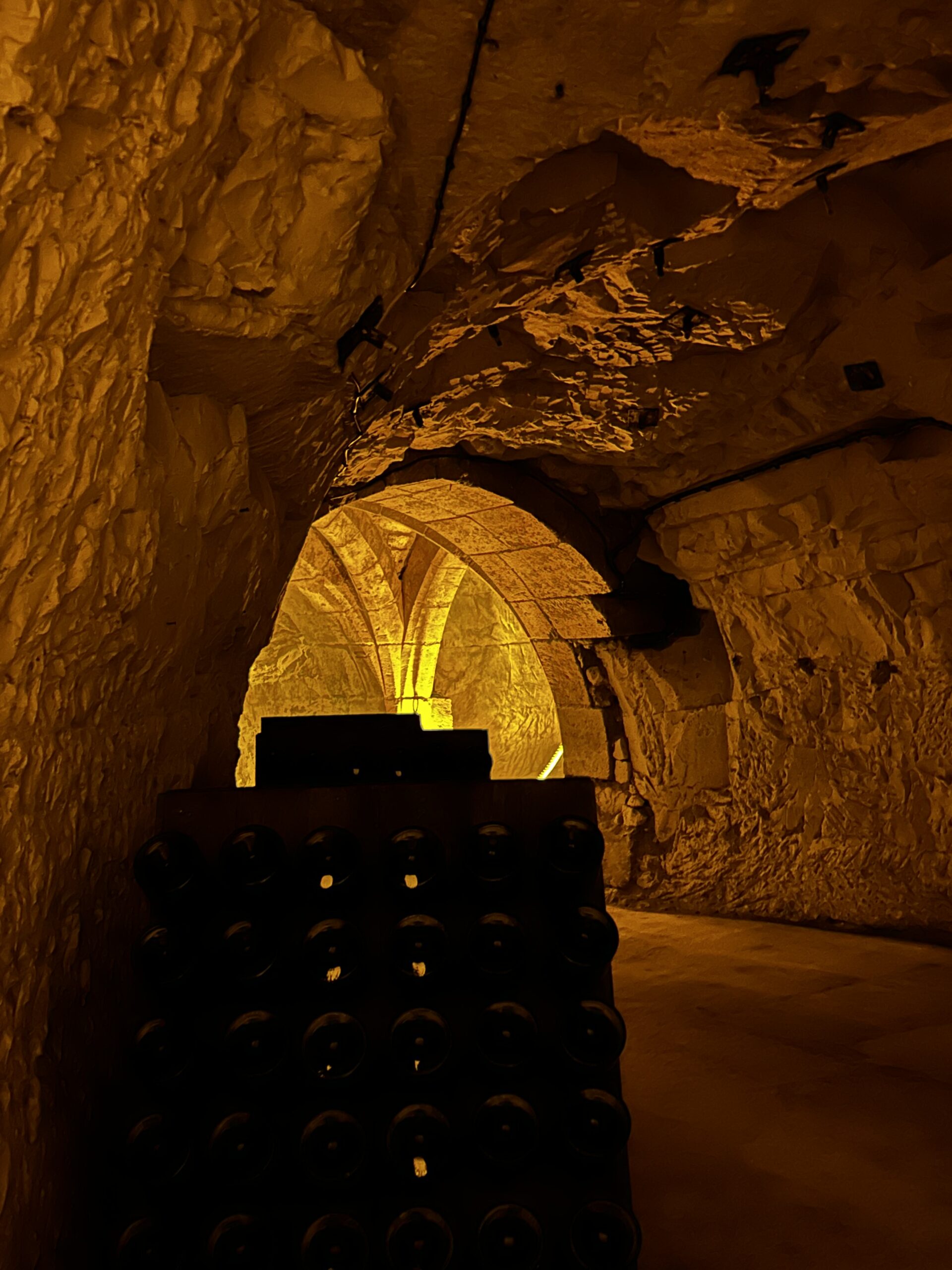
Under Reims runs something most of the people drinking its wine never see: roughly 250 kilometres of chalk galleries, the oldest of them crayères dug by the Gallo-Romans from the fourth century, vast bottle-shaped pits cut to quarry building stone and then forgotten. The Champagne houses worked out, centuries later, that what the Romans had left behind was perfect. Thirty to forty metres down, pitch dark, a constant ten to twelve degrees, the humidity steady, the chalk drawing damp from the air. The Hillsides, Houses and Cellars of Champagne have been a UNESCO site since 2015.
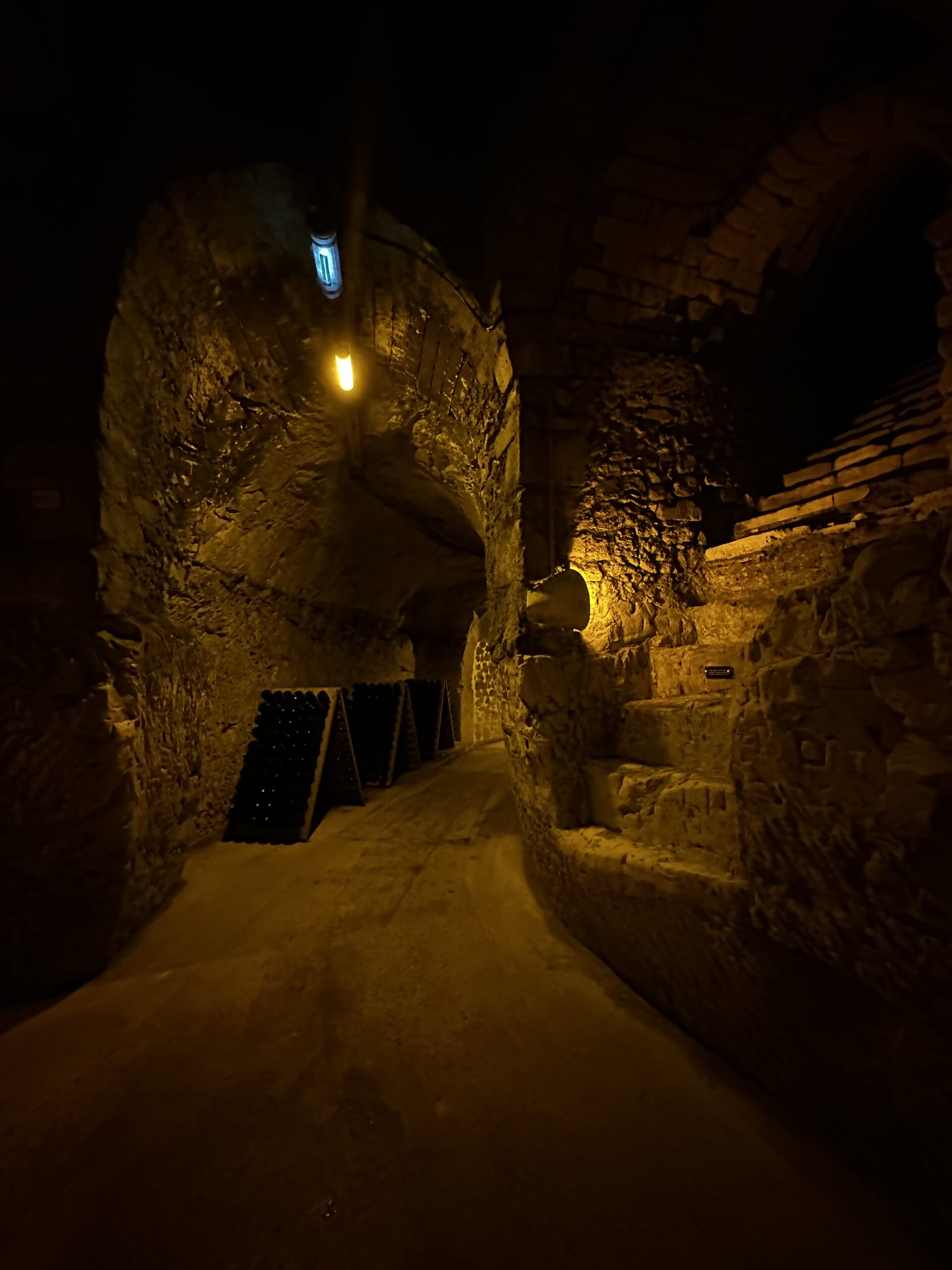
To descend into a maison's crayères is to walk through a Roman quarry that became a cathedral of wine. At Ruinart, the oldest established house, the pits plunge some thirty-eight metres on the Saint-Nicaise hill, the chalk pale and faintly luminous; at Taittinger, the galleries thread the cellars of a thirteenth-century abbey above the same Gallo-Roman workings. Down here the bottles rest at an angle, neck downward, in racks called pupitres. This is where the slow patient theatre of the method happens: the second fermentation that puts the bubbles in, then remuage, the daily eighth-turn by a remueur's hand or a gyropalette, coaxing the spent yeast into the neck to be disgorged.
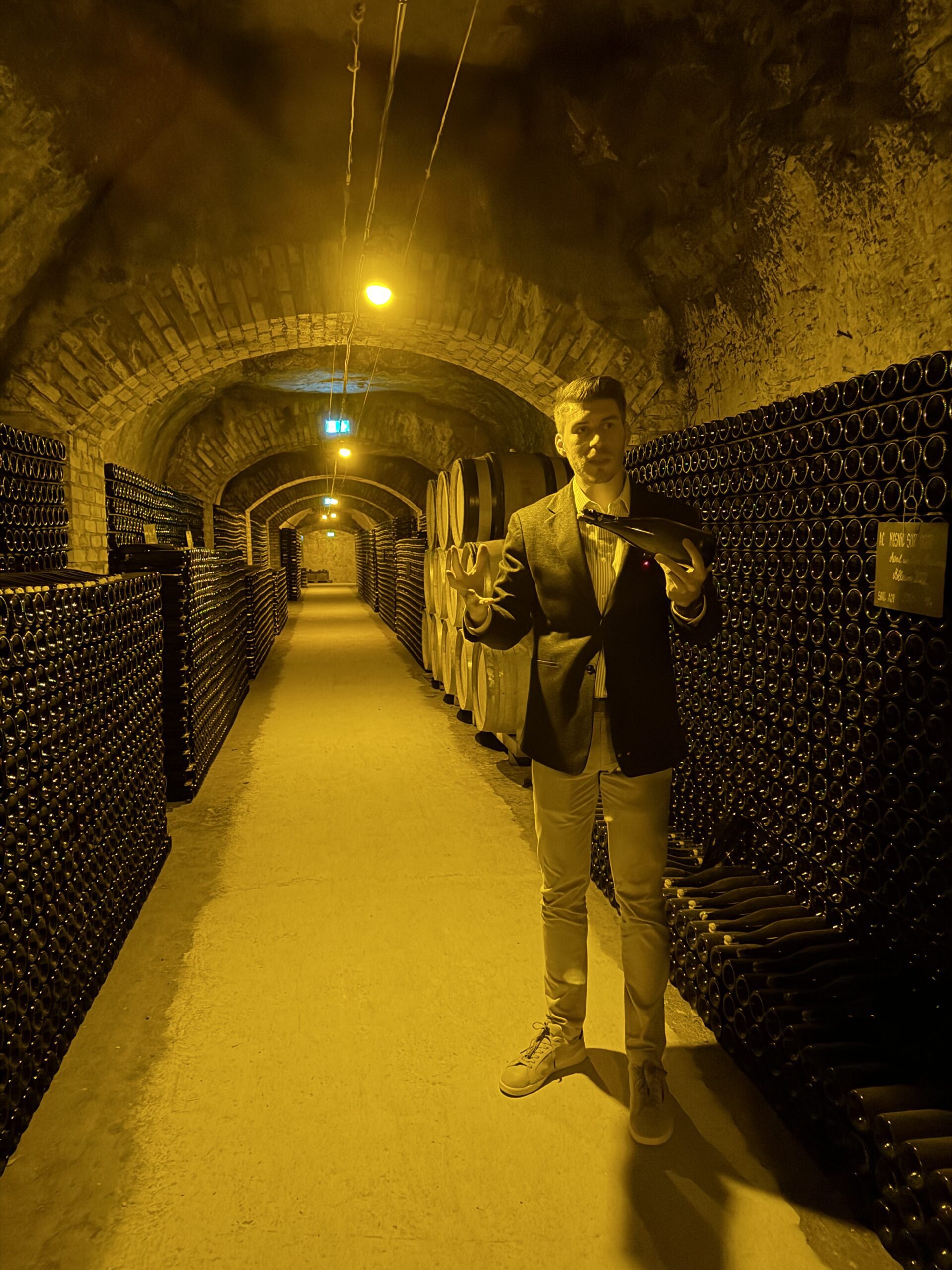
The numbers in the dark are hard to take in. Millions of bottles lie turning slowly while the city goes about its business overhead, each one ageing in silence for years before release. We arrange the descents that the public tour does not reach: a private walk through a single house's cellars with its chef de caves or cellar master, a tasting at the foot of the chalk where the wine is actually made. The Champagne is grown up there, in the vineyards. It becomes itself down here.
Naples: Two Thousand Four Hundred Years, Straight Down
Naples is loudest at street level; its real depth is literal. Some forty metres beneath the traffic lies a stack of the city's whole history, all of it carved from the same soft yellow tuff, the volcanic stone that makes Naples both buildable and hollow. The Greeks cut that tuff for the walls of Neapolis. The Romans, under Augustus, turned the quarries into a vast aqueduct, fed by the Serino springs some seventy kilometres away, channelling fresh water under the streets through cisterns the colour of honey.
Then history folds in on itself. In the Second World War, as Allied and German bombs fell, the same Greek and Roman cisterns became air-raid shelters, and Neapolitans went down into the dark to wait. The traces are still there in the tuff: rusted bedframes and thin mattresses, an old radio, a sewing machine, children's toys, and on the walls the dates, prayers and scratched phrases of people who waited in fear. Elsewhere in the city lie the early Christian burial galleries of the Catacombs of San Gennaro, and the bone-stacked Fontanelle ossuary, where the city kept faith with its dead.
You enter through an ordinary doorway on an ordinary street, descend the narrow stair, and 2,400 years open up beneath your feet. We send you down with an archaeologist or a guide who knows which tunnel leads where, after hours when the galleries are empty and the tuff gives back nothing but the sound of dripping water. Few Italian cities wear their past so lightly above ground and keep it so completely below.


Cappadocia: A City That Could Disappear Underground
In Cappadocia, when danger came, an entire town went down. Derinkuyu descends roughly eighty-five metres through as many as eighteen carved levels, of which about eight are open to visitors today, and at its height could shelter as many as twenty thousand people, with their livestock, wine and oil presses, stables, refectories, chapels and stores. It was cut entirely by hand into volcanic tuff, the same soft ash-stone that lets the whole region be carved like cheese and then hardens in the air.
The engineering is the marvel. More than fifty ventilation shafts, some over fifty metres deep, brought air to every floor and doubled as wells and as a way to call between levels. Great circular stone doors, discs a metre and more across and weighing as much as half a tonne, rolled across the passages and could be barred from the inside only, sealing each floor off on its own. The origins reach back to the Phrygians, perhaps further, and it was dug deeper through the Byzantine centuries by early Christians sheltering from the armies overhead.
Above ground, the same soft rock holds the painted rock churches of Göreme and the fairy chimneys that draw the dawn balloons. Below it, a civilisation learned to vanish. We take you down with a guide who can read the shafts and the doors, and pair the descent with a stay in a cave hotel carved from the same stone, so the strangeness never quite lets go.


The Dordogne: The Last Real Cave You Can Still Stand In
Almost all the great painted caves are closed now. Lascaux was found in September 1940 by four teenagers and a dog, opened to the public after the war, and shut again in 1963: artificial light and the breath of visitors had faded the colours and bred algae on the walls. What you see at Lascaux today is a facsimile, Lascaux IV, a full-scale copy four hundred metres from the original on the hill above Montignac. It is brilliantly done. It is still a copy.
Font-de-Gaume, near Les Eyzies, is the exception, the last cave in the world with prehistoric polychrome paintings still open to the public. Discovered in 1901, its walls hold more than two hundred images, among them some eighty bison, around forty horses and more than twenty mammoths, painted in the Magdalenian period some seventeen thousand years ago. You walk in along a narrow corridor of rock and the animals emerge from the stone in red ochre and black manganese, drawn so the swell of the rock becomes the swell of a flank.
You cannot bring this home, and you cannot fake it. Stand in front of the copy and you admire the skill. Stand in front of the real wall, where a hand pressed pigment into living rock before farming, before writing, before history, and the seventeen thousand years are in the room with you. Numbers are kept tiny, only a few dozen people a day, and tickets are released on a strict schedule far in advance; this is precisely the kind of access we secure and time for you. There are very few places left where that is possible. The Dordogne is one.


Saint-Léonard: A Lake You Cross by Rowboat, in the Dark
Between Sion and Sierre, under the terraced vineyards of the Valais, there is a lake nobody planned for. The Saint-Léonard underground lake lies thirty to seventy metres down inside the hillside, water that has spent thousands of years dissolving a seam of gypsum into one long cavern, walls of black schist with a band of marble closing it in. At three hundred metres end to end it is the largest natural navigable underground lake in Europe, and the only way across is the way the first explorers went: in a rowing boat, in near silence, on water so still the drip from the ceiling carries the length of the cave.
It was found in 1943 by a speleologist, and it might have stayed a rumour, the water then standing too high to cross. Then in 1946 an earthquake opened new fissures, the level dropped, and the lake could be entered. You go down a metal stair to a jetty, step into a flat-bottomed boat, and a guide rows you out over water that holds a steady cool temperature all year, clear enough to watch trout hang in the lit green below. No engine, no commentary shouted over a crowd. Just the oar and the stone.
The reason to come is what the rock does to sound. The cave is a natural concert hall, and a few times a season a musician is rowed out on a second boat to play while the audience floats a few metres off, the notes folding around the stone in a way no built room can copy. We take the lake privately, outside opening hours: a boat of guests, an apéritif of Valais wine grown in the vineyards directly overhead, music carried across the black water seventy metres beneath the vines. You came to Switzerland for the peaks. The strangest thing here is beneath them.


Underground Europe: Common Questions
What is the most spectacular underground site in Europe?
It is a matter of taste. Saint-Léonard's underground lake and Cappadocia's underground cities are the show-stoppers; Champagne's Roman chalk cellars are the most civilised; and the Dordogne's painted caves are the most moving.
Are these underground places cool in summer?
Yes. Most sit at a steady ten to seventeen degrees while the surface bakes, which makes them ideal hot-weather visits, calm and quiet.
Can you still see real prehistoric cave paintings in the Dordogne?
Lascaux is closed and you see a facsimile, but Font-de-Gaume is the last cave with original polychrome paintings still open to the public. Numbers are tiny, so book far ahead.
Do you need to book underground visits in advance?
Yes, especially Font-de-Gaume, the private cellars of a Champagne house, and a private evening on the Saint-Léonard lake. We arrange the access and the timing.
Are they difficult or claustrophobic to visit?
Most are well-lit, walkable galleries rather than tight crawls. Private access makes them calm and uncrowded.
The coolest, strangest Europe is the one under your feet
We arrange the descents that are hard to get, the private cellar, the timed cave slot, the right guide underground. See how we travel Europe, or tell us which descent you want to make.
Write to Marie