
A menu you can only eat at the source: foods so rare, so fragile, or so local that the only way to have them is to go.
The menuA handful of foods in Europe still cannot be bought. Not because they cost too much. Because they refuse. They are made by three women left alive, or sold through a hatch so you never see the nun, or grown where the men who harvest them drown, or alive at dawn and worthless by dark. They do not ship, they do not scale, and they have never heard of you.
The modern instinct is that anything good enough will eventually reach you: flown in, vacuum-sealed, reverse-engineered in a test kitchen, sold under a softer name. Most things do travel. These do not. Some spoil in the hours between the boat and the table. Some are illegal to carry across a border. Some are made by so few hands, on so few days, that there is barely enough for the parish that has always eaten them. The copy exists, and the copy is always a letdown, in a way you cannot quite name until you have tasted the original.
You go to them, on their terms, or you spend your life eating the copy and calling it the original. This is the menu. None of it is for sale. All of it is worth the trip.
The Menu, Course by Course
Why each one stays home.
| Dish | Where | Why it can't travel |
|---|---|---|
| Su filindeu | Nuoro, Sardinia | Almost no one can still make it |
| Percebes | Galicia | Harvested at peril, eaten same day |
| Angulas | Basque Country | Critically rare, barely keep |
| Ricci di mare | Sicily | The roe turns the moment it's cracked |
| Bleu de Termignon | Savoie | Wild blue; some wheels never turn at all |
| Culatello | Po valley | Made by the river fog itself |
| Convent sweets | Portugal & Spain | Secret recipes, sold through a hatch |
| Gelato | Nice | Melts; never leaves the counter |
The Pasta Almost No One Can Still Make
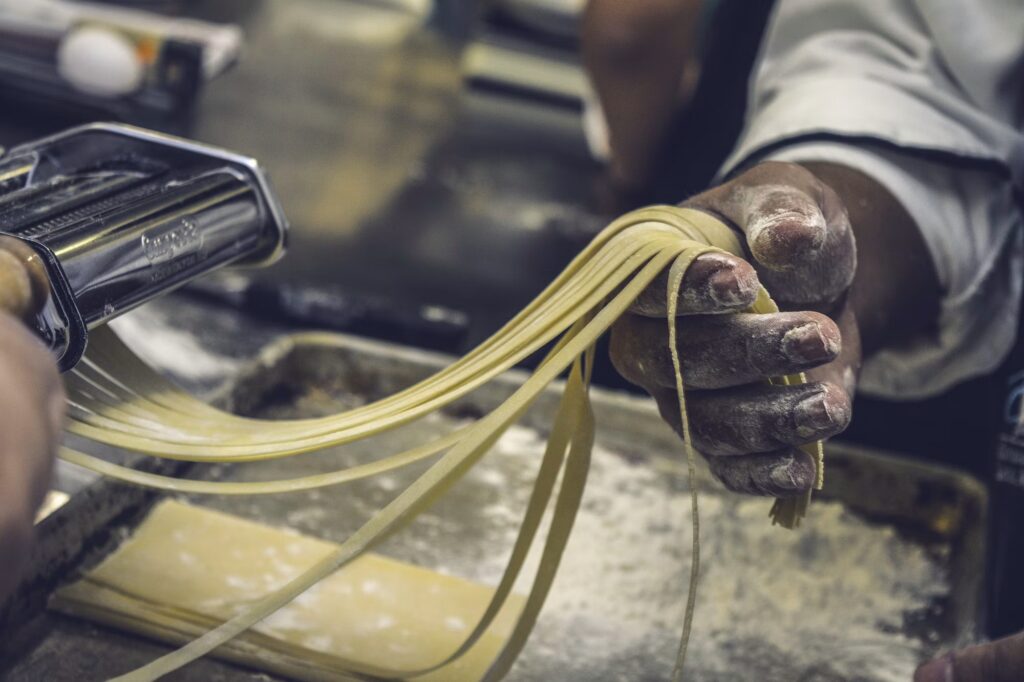
In Nuoro, in the mountains of Sardinia, a few women still make su filindeu, the threads of God. The dough is nothing unusual: semolina, water, salt, worked until it tells the maker, through the hands alone, that the moisture is right. Then the difficult part. It is pulled and folded, pulled and folded, doubling each time, until a single piece becomes hundreds of strands finer than a hair, which are then laid across a round wooden frame called a fundu in three crossing directions, layer over layer, and left to dry into a pale sheet that looks woven rather than cooked.
It is held to be the rarest pasta in the world. The Abraini family of nearby Lula have made it for more than three hundred years, and at one point only three women alive knew how. One of them, Paola Abraini, works for the best part of a month before the feast, hours at a stretch, to produce the quantity the village needs. Barilla, who can extrude almost anything, sent engineers to study it and could not reproduce by machine what the hands do by feel.
It exists for one purpose. On the days around the feast of San Francesco di Lula, the dried sheets are broken into pieces and dropped into a broth of fatty mutton, with grated pecorino sardo stirred through until it melts into threads of its own. Pilgrims who have walked through the night arrive to find it waiting. You cannot buy it, and you cannot be taught it in an afternoon. JOAL arranges for you to sit in the kitchen while it is made, to watch the doubling and the laying of the threads, and then to be handed a bowl on the right days, in the only place it is served. To be there for it is not a reservation. It is an introduction.


Three Things That Die on the Way Home
Percebes, Galicia. On the Costa da Morte, the coast of death, men climb onto rocks the Atlantic is trying to kill them on, to tear off goose barnacles that taste like the cleanest mouthful of the sea. They grow where the swell hits hardest, around Fisterra, Camariñas and Malpica, because the violence of the water is what feeds them. The percebeiros go out on the lowest tides, often before dawn, one hand working a short blade called a rasqueta under the cluster while the other reads the next wave. Several die each year along this coast. What they bring up is dropped into seawater the moment it boils and lifted out a minute later; you snap the leathery stalk, and what is inside is briny, faintly sweet, gone in a mouthful. It does not keep. It was alive an hour ago.
Angulas, the Basque Country. For a few weeks around Christmas the rivers give up baby eels, glassy and the length of a matchstick, now among the most expensive things you can eat in Spain. The European eel is critically endangered, the price is absurd, and the pale lookalikes in the supermarket freezer are gulas, surimi pressed into shape and given a black dot for an eye. The real ones are eaten in a small earthenware cazuela, flashed in olive oil with garlic and a slice of chilli, still sizzling. Ricci di mare, Sicily. With sea urchins it is a matter of hours, not days; the roe turns the moment the shell is cracked, so the one opened in front of you on the quay cannot be the one shipped frozen across the world.
None of this survives a journey, which is the entire point of going. JOAL takes you out at first light with a licensed harvester on the Galician rocks, or to the market at dawn and then to the table that buys the best of the morning's catch. The cook is someone we know; the timing is the season, not the diary. You eat it where it was pulled from the water, because there is nowhere else it can honestly be eaten.


The Cheeses You Cannot Take Home
Bleu de Termignon, Savoie. High in the Vanoise, above the Haute-Maurienne, a handful of farms still make a blue cheese that no one fully controls. The herds climb to the summer pasture once the snow clears, usually by mid-June, and the raw milk is worked by hand in wooden chalets, some of them centuries old. What sets it apart is what the makers leave out: the paste is never seeded with mould, never pierced with needles. The blue, when it comes, arrives on its own, from spores living in the wood of the moulds, the draining boards, the damp cellar walls. Some wheels marble through with slate blue. Some stay almost white, barely freckled. Some never turn at all and are sold just the same, because here that is the weather of a given summer rather than a flaw. Cut one open and you are tasting a single alpage and a single July, in a form that will not repeat next year, let alone survive being made anywhere else.
In the Jura, Vacherin Mont d'Or makes the same point more bluntly. A cheese of the cold months, bound in a band of spruce bark and soft enough by January to eat with a spoon, its French raw-milk version is aged about three weeks, well under the sixty days the United States and Australia demand of imported raw-milk cheese, which is why it is banned from import. One cheese you cannot take home because the law forbids it. The other because it never holds still long enough to be the same cheese twice.
Ripeness is the whole argument, and ripeness does not wait in a customs queue. JOAL takes you into the cellar where an affineur turns the summer's wheels and coaxes the blue along the curds' own fault lines, or admits, some years, that it simply will not come, and to the table of the family who carried the milk down from the pasture. You taste the season's cheese beside the people who made it, learn the herd it came from, and leave understanding why no two summers, and no two wheels, are ever alike.


A Ham the Fog Makes
In a handful of foggy towns of the Bassa Parmense, the strip of low plain between Parma and the Po, with Zibello chief among them, they make culatello, what chefs call the king of salumi. Where a prosciutto is the whole hind leg, the culatello is only its heart: the central muscle of the thigh, boned and hand-trimmed into a pear shape, then sewn into a pig's bladder and tied in a wide irregular net of string so the cellar can breathe into it. One leg gives a prosciutto. The same leg, butchered this way, gives a single culatello and a deal of waste, which is part of why it costs what it costs.
It is salted, rested, cased, and then hung in dark cellars for twelve to thirty months. From autumn the river fog, the nebbia, rolls off the Po and fills those cellars night after night, and that damp grows a living bloom of moulds across the casing that exists nowhere drier. The meat comes through the fog of one winter and the heat of the following summer and is ready the winter after that, the slice almost translucent, scented and yielding in a way prosciutto never quite reaches.
It cannot be made anywhere with less humidity, and was kept out of the United States for more than forty years on hygiene grounds tied to its raw, bladder-cased ageing. The fog is the recipe, and the fog does not travel. JOAL brings you down into a working cantina along the Po with the family that has tied these by hand for generations, to see the bladders hanging in the gloom and to eat a culatello they choose and slice for you. The fog is doing its work outside the window while you taste what it made.


Recipes Kept Behind Walls
Most of Portugal's great sweets were born of thrift behind cloister walls. The convents used egg whites in quantity, to starch the nuns' habits and to clarify their wine, which left mountains of yolks with nowhere to go. So the nuns turned the yolks into pastry, and a whole tradition, the doçaria conventual, grew out of what would otherwise have been thrown away. When the religious houses were dissolved after 1834, the recipes spread outward as a way to keep eating; the celebrated Portugal custard tart, the pastel de Belém, has been made from the old Jerónimos monastery recipe in the same Lisbon shop since 1837, and the formula is still kept secret to this day.
Pastéis de Tentúgal. A Carmelite invention of the sixteenth century, a pastry rolled and stretched by hand until it is almost transparent, then filled with ovos moles, the soft sweet egg-yolk cream; the humidity of the place is part of how the dough behaves. Ovos moles de Aveiro. The same cream sealed inside thin wafer shells moulded as fish and shells and barrels, sold from the lagoon town where it was first made. They are fragile, perishable, and tied to a single place.
Dulces de convento, Spain. In the cloistered convents of Seville, nuns still bake from recipes they do not share and sell them through a torno, a revolving wooden hatch set into the wall: you leave your coins, the shelf turns, the sweets come round, and you never see the nun. JOAL knows which grille to knock at and on which morning, and can arrange the rarer thing still, a quiet word with the order, a tray brought out fresh, the convent kitchen opened for an hour. You taste what the walls were built to keep in.


Ice Cream: The Most Fragile Thing of All
The most fragile thing of all simply melts. Proper gelato is not ice cream made smaller; it is a different thing, built on different numbers. Where American ice cream carries fourteen per cent or more butterfat, a true gelato sits nearer four to eight, so the flavour is not muffled in fat. It is churned slowly, drawing in only twenty to thirty per cent air against the fifty to a hundred of the industrial tubs, which is why it tastes dense rather than fluffy. And it is served warmer, by ten or fifteen degrees, soft enough to read on the tongue rather than numb it.
All of that makes it perishable in the extreme. The final churn, the mantecazione, turns the liquid to a creamy solid in the machine, and from that moment the clock is running. It cannot be frozen rock hard, shipped, or held for long without coarsening into something else; the best of it never travels further than the counter it was made on that morning.
Nice is an honest place to finish. Until 1860 the city was not French at all but Savoyard, ruled from Turin, and only the treaty of that year drew the border below it. The kitchen never quite forgot. The ice cream made in the lanes of the old town is gelato by descent and Niçois by address, churned small, kept soft, the fruit and the pistachio left to speak for themselves.
JOAL takes you behind the counter before the doors open, to stand with the maker through the mantecazione and eat a flavour at the one moment it will ever be that good. It would not survive the walk to the car, let alone the flight home, which is exactly why you come to a back lane of Vieux Nice for it, while it is still soft enough to read on the tongue.


Food That Doesn't Travel: Common Questions
Why can't you buy these foods at home?
Each one resists in its own way: it spoils within hours, it is illegal to import, or it is made by so few hands there is barely enough for the village. What gets exported, if anything, is a shadow of the real thing.
Which is the rarest?
Su filindeu, the Sardinian threads of God, made by only a handful of women and impossible to mechanise, is widely held to be the rarest pasta in the world.
Why is Vacherin Mont d'Or banned in the United States?
It is raw-milk and aged under four weeks, below the sixty-day ageing the United States and Australia require for imported raw-milk cheese.
When is the best time to taste them?
They are seasonal: angulas around Christmas, Vacherin in winter, percebes and sea urchin by season. We plan trips around the calendar so you arrive when each is at its best.
Can you arrange to meet the producers?
Yes. The access to the family, the cellar, the boat or the bakery is the whole point, and the part we are here to open.
We know the village, the season, and the family
These are not restaurant bookings; they are introductions, timed to the season and the source. See how we travel Europe, or tell us which table you want to sit at.
Write to Marie